A wearable pressure sensing device and mobile app that guides targeted compression therapy, with a secure cloud database and web app for monitoring and maintenance.
Resources
Tight Alright videos
Explore our video library to discover real-world challenges and innovative solutions.
Tight Alright instructions for use and product brochure
Consult Instructions for Use, as well as visual guidance for using Tight Alright to guide compression, and the product brochure.
About Us
Who We Are
Read about our purpose, skilled management teamand celebrated innovation awards.
Stay updated on company news, request a Tight Alright demo and reach out for more information.
Compression therapy: the gold standard to treating VLUs
How compression therapy works
Before compression
After compression
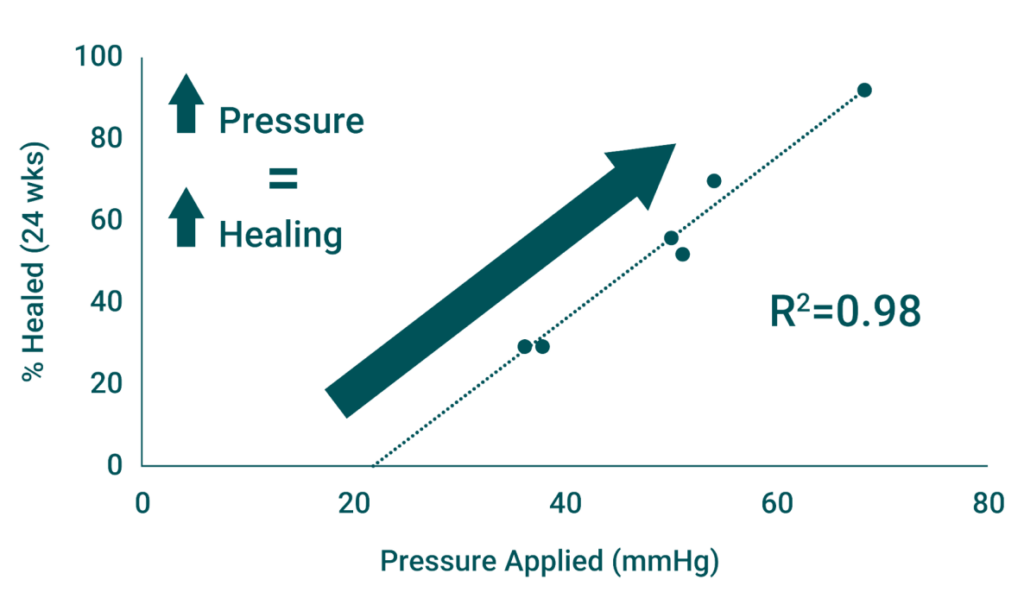
Effect of compression pressure on VLU healing
Studies have shown that the pressure applied during compression is critical to driving VLU healing. However, this must be balanced with safety and patient tolerance (compliance).
O’Meara et al. Cochrane Database Syst. Rev. (2012)
Karanikolic et al. Phlebology (2017)
Milic et al. Journal of Vascular Surgery (2010)
Karanikolic et al. Dermatologica Sinica (2019)
VLU Healing Rate vs. Pressure Applied*
Current limitations of compression therapy
at point-of-care
Moffatt et al. International Wound Journal (2009)
Protz et al. Dermatology (2014)
Ennis, W. iWoundsNews. 2020
Relevance according to clinical guidelines
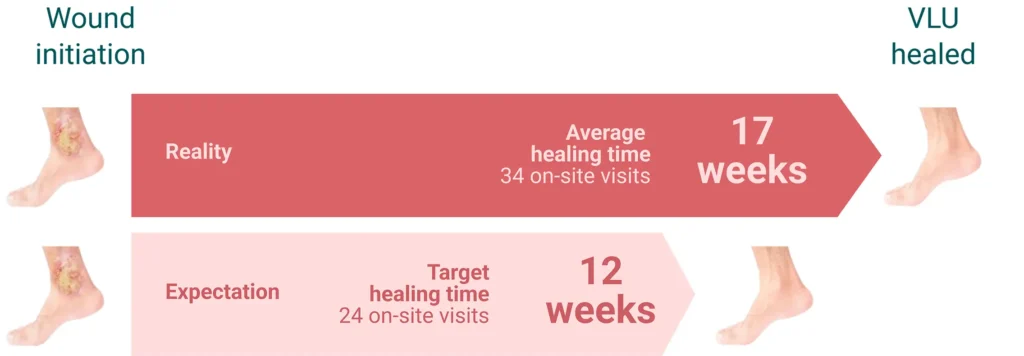
The expectations and reality of VLU healing times
There is a critical need for effective methods to enhance healing rates
of patients did not achieve healing
of VLUs do not heal within one year
Let’s stay connected!
Stay updated on our latest events, insightful case studies, informative videos, and more!